
Seven-ping Sunday (15)
Of jibs and pingchronicities

Not much of a week to celebrate in the Cape’s broader picture, but pings did ring (forgive the melodrama :)).
Monday ping. The night of the great storm, I, like many (Click here for Marita Bester) spent it sleeplessly, diving down storm-tossed rabbit holes. Except mine, because I had just completed writing an article on James Kagambi, the first Kenyan to summit Everest, took me to those snowy Himalayan slopes and reels of queues of people readying for the season’s first climb. And the news that three had already died in the grand quest to summit the world’s highest mountain.
Which sadly echoed the initial storm fatality list – at least five deaths from falling trees reported, and, much later, 90 000 displaced. Besides the devastation pictures and reels, though, good news stories there were: inter alia the Good Things Guy, the dude who went for a run along Sea Point and pushed a homeless wheelchair-bound man in the rain, the video of which earned him over R400 000 in donations, and the NSRI rescue of 23 farmworkers near Worcester.
When my brother called me the next morning to check if I was alive, he had just learnt a new unrelated old-fashioned idiom by way of compliment to his business persona: “I like the cut of your jib”. Maritime, by all accounts, referring to the triangular sail at the front of a ship. So, to the Good Things Guy and the NSRI then, Ping ping jib jib!
Substack post of the week. “And then from Wednesday the sky cleared, the sun shone as if nothing had happened. Like a violent lover whose anger cycled unpredictably.” Click here for Chantel Erfort Manuel’s piece ‘When the storm passes’.
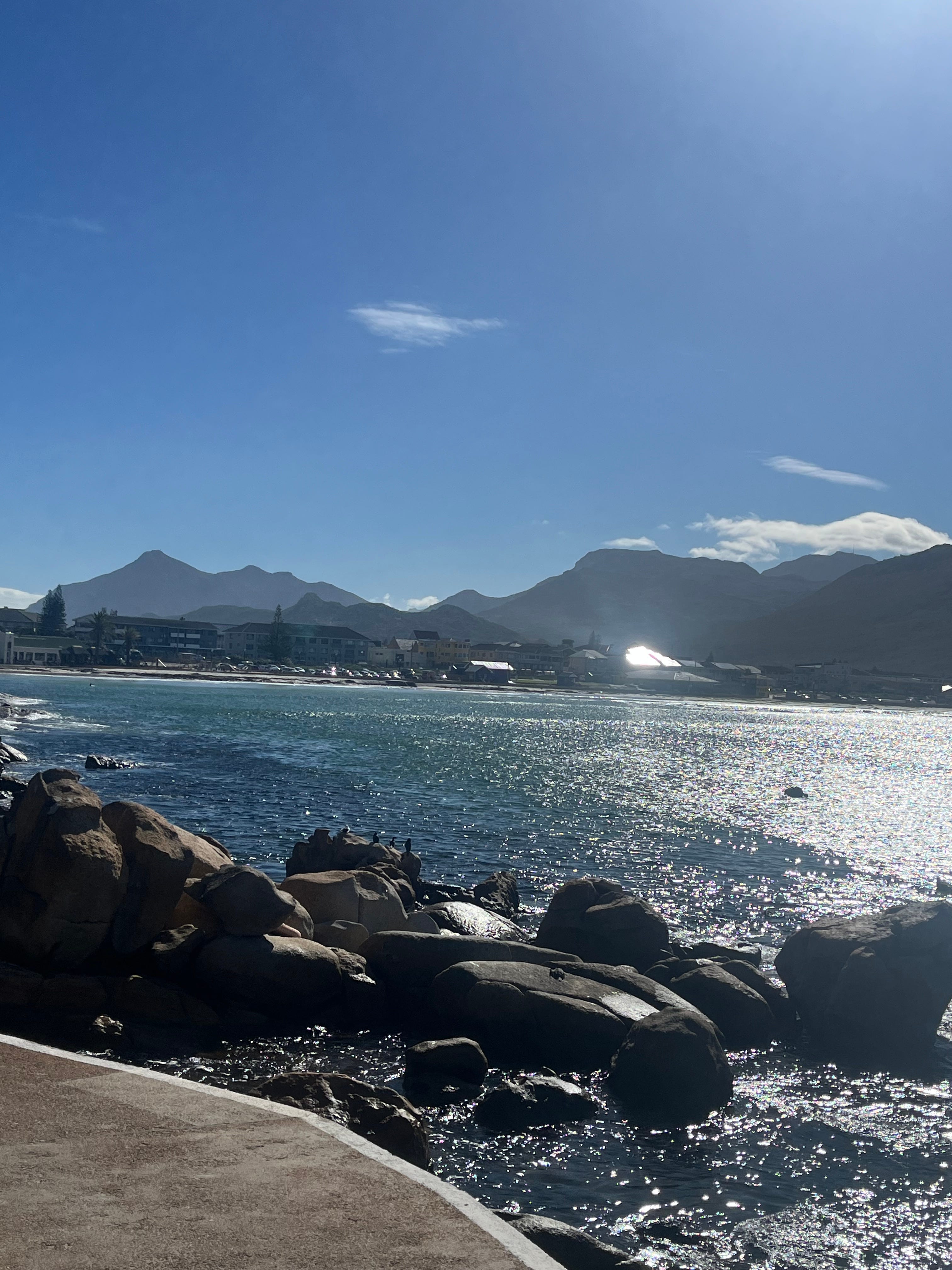
On Thursday I took a slow walk out Skellies way in Fish Hoek and the sun reflected from a roof across the bay like a divine totem. As if to say, all is forgiven, all’s well, keep walking. But there was a hobbledness in my gait and that of fellow walkers, or at least it felt that way. Saved human lives though there were, some lost all their livestock; what had been seen could not be unseen.
Read of the week. Other things that happen twixt stormbound rabbit-holing (a politer and more productive term than doomscrolling), writing and completing your astrology assignment, are to repack the bookshelf. Or at least tidy up the books scattered randomly about in a state of semi-readness. Enter ‘Tambora, the eruption that changed the world’, by Gillen D’Arcy Wood, a much-salivated-over tome about the 1815 Indonesian volcano which gave the world a year without a summer, borrowed from my brother-in-law a few weeks ago. Suddenly, like Everest, analogies erupted. Climatic breakdown took on a new dimension – “after April 1815, many human societies were ‘changed, changed utterly’ – to borrow from the poet W.B. Yeats” – what had been seen could not be unseen.
Ancestral ping. Where tragedy bleeds, often synchronicity breeds. 1815. A ping bell goes off! Burrow, burrow, pink file, blue file, lilac – Marshall ancestors. My memory served me right. While Joseph Turner was churning out paintings of London with atmospheric sunsets and skylines, my paternal great great great grandfather was knotting the banns in the city’s risque East End. In St Anne’s in bustling Limehouse nogal. A Nicholas Hawksmoor church which I visited about 15 years ago. Nicholas Hawksmoor, who for the uninitiated, was a baroque architect extraordinaire who was thought to have dabbled in the occult. Origins of the pyramid (inscribed with ‘The wisdom of Solomon’) in the churchyard abound, but some have it that, because Hawksmoor was a freemason, the pyramid was Masonic symbolism. Author Iain Sinclair has theorized that Hawksmoor’s East London churches (there are six) form a map of ancient symbols and hieroglyphs.
A silversmith by trade, my ancestor joined the settler parties of working class Brits who left for South Africa in 1820. Doubtlessly clueless about farming, he was nevertheless given land outside Grahamstown and his direct descendants farmed outside Cathcart where a graveyard of his kin remains today. Historical tidbits.
Pingronicity. The second night of the great storm, substack scrolling took on a new dimension when I happened on a collaboration with the hallowed of hallowed Maria Popova of Marginalian (ex Brain Pickings) fame. (Click here)
Not only did she, who strives to marry poetry and science, allude to a Hawksmoor church (St Mary Woolnoth) in a mention of TS Eliot’s ‘The Wasteland’ but she mentioned Tambora because the eruption is what caused Mary Shelley, her idol, to hide out for days on end, escaping the foul weather caused by the eruption, at Villa Diodati near Lake Geneva in 1816. This isolation period saw the writing of ‘Frankenstein’. The villa was named for the rich and powerful Italian Diodati family, one of whom was a Dutch East India Company governor on Mauritius and married the granddaughter of Krotoa, South Africa’s first indigene to marry a European, in the late 1600s. Read the back story here.
Poetic ping. As said, the second night of the great storm, substack was my best friend. With, inter alia, Mike Nicol, who, on his way to Franschhoek Literary Festival (where I managed to slip in three sessions, not his, sadly, but ping ping jib jib to Julia Martin, Tony Jackman, Sally Andrew and Sarah Bullen especially), dropped in some curious thoughts about Eliot’s haunting poems. More pingchronicity! Click here
Modern ping. “Have you ever felt that gentle pain
That only rain in secret silver nights can soothe?”
Have no idea which contemporary anthology I found these lines in many monsoons ago (and should anyone wish to keep them, copyright is held by the writer!), but my amygdala suddenly seemed to ignite with memory. Go figure!
Till next week,
Ping ponderously,
Sharonski
Thank you for the mention 💜
You did a lot more storm reading than I did. 🤔🌻Thanks for all the fascinating pings and the mention.🌻.